What Is the Real Purpose of a Lead Magnet in Online Marketing?
(It’s Not What Most People Think)

Recently, Meta AI asked a question inside the GHL Business Launch Facebook group, https://www.facebook.com/groups/ghlbusinesslaunch, that sparked a surprisingly rich discussion:
“What is the primary purpose of a lead magnet in online marketing?”
Some responses were shallow. Some were insightful.
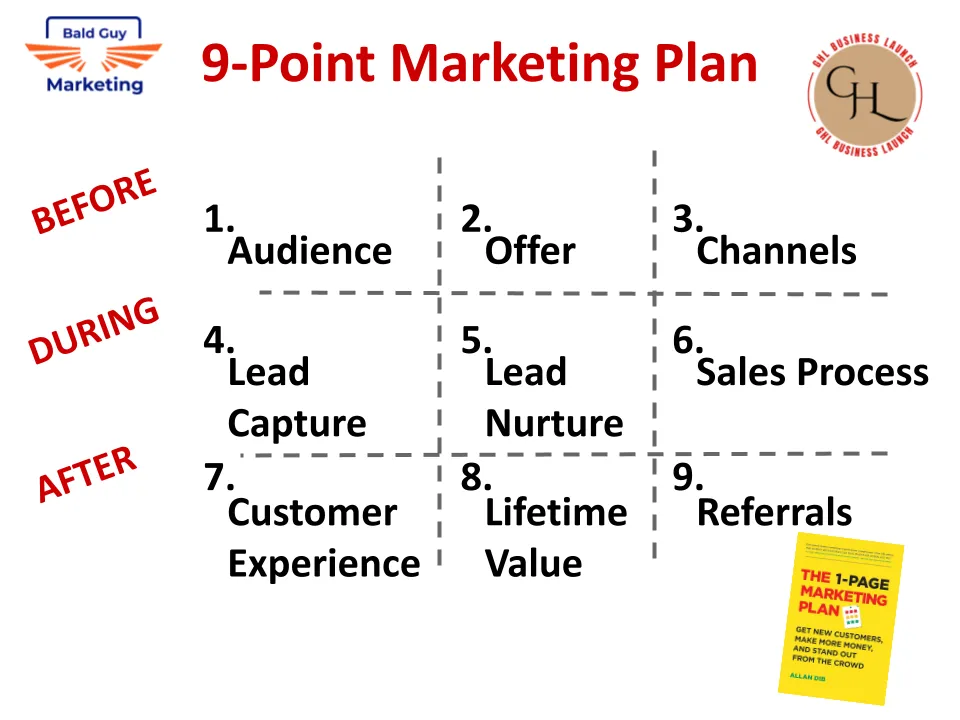
All of them created an opportunity to revisit what a lead magnet really is—and how it fits into the broader strategy behind Allan Dib’s Nine-Point Marketing Plan from The One Page Marketing Plan.
Here’s what surfaced.
1. What People Commonly Say About Lead Magnets
Response 1:
“To attract a lead.”
Accurate… but nowhere near the full picture.
Response 2:
“To get contact details for leads who are interested. It’s a top-of-funnel process requiring further education and qualification.”
Absolutely—this aligns with Points 4, 5, and 6 of the Nine-Point Marketing Plan:
Lead Capture
Lead Nurture
Sales Process
Response 3:
“To offer a solution that leads the ideal client into the full sales process.”
Yes—this nails the concept of a micro-commitment. The prospect thinks they’re receiving something complete, but they’re actually beginning a guided journey toward your flagship offer.
These answers get us part of the way there.
But they still miss the deeper strategic intent.
2. The Deeper Purpose (and Devin Tracy’s Formula)
As Devin Tracy teaches inside GHL Business Launch, the Omny Hub Challenge, Settle Your Side Hustle, and his mastermind programs:
A lead magnet is a specific solution to a specific part of a problem
that naturally helps the prospect recognize they have a bigger problem—
one that your core offer solves.
In other words:
A lead magnet does NOT close the sale.
A lead magnet begins the relationship.
It works because commitment is low.
Unlike a tripwire offer (low-priced product designed to self-liquidate ad spend), a lead magnet is:
free,
problem-specific, and
valuable enough to justify sharing contact information.
It’s an invitation—not a transaction.
3. How Lead Magnets Fit Into the Nine-Point Marketing Plan
(From Allan Dib – The One Page Marketing Plan)
A lead magnet isn’t an isolated tactic.
It sits at the crossroads of a well-structured strategy:
1. Identify Your Target Market.
Your lead magnet must speak directly to the ideal client—not “everyone.”
2. Craft Your Message to Get Their Attention.
People don’t need another PDF.
They need solutions.
3. Place the Message Where They Are Already Listening.
Knowing where your ideal audience gathers makes distribution easy.
4. Capture the Lead — this is where the lead magnet lives.
The exchange must feel obviously valuable to the prospect.
5. Nurture the Relationship.
Following up is not optional.
Start by asking: “Was this helpful?”
6. Present the Sales Opportunity.
When trust is established, you can offer the next-level solution.
7. First Impressions Shape Trust.
How your lead magnet is delivered and experienced sets the tone for everything that follows.
8. Lifetime Value Comes From Long-Term Relationship Building.
The real ROI emerges when nurtured leads become long-term customers.
9. A Great Lead Magnet Is Shareable.
Make it something your fans want to send to others.
4. The Core Insight
If I were to summarize the real purpose of a lead magnet, it would be this:
A lead magnet is a valuable, problem-specific resource designed for your ideal client avatar.
Its purpose is to ethically capture contact information, build trust, and begin a nurturing sequence
that leads naturally to your flagship offer.
A lead magnet is not the end of the funnel.
It’s the first impression—
your opening handshake,
your demonstration of value,
your customer experience in miniature.
And that first impression can either open a door…
or close one forever.


