Referral-Ready but Referral-Invisible
Why Great Networking Relationships Don’t Always Produce Referrals
By my second year in BNI, something had begun bothering me.
Some members seemed to generate referrals for one another almost every week.
They formed power teams: real estate professionals, lenders, insurance agents, title professionals, contractors, and other businesses whose customers naturally moved from one service to the next.
Other members did everything they were supposed to do.
They showed up.
They built relationships.
They conducted one-to-ones.
They taught the chapter what they did.
They gave specific referral requests.
They developed credibility.
They regularly referred business to other members.
And still, referrals coming back to them were few and far between.
I remember an emotional-eating coach who worked primarily with women. I remember a consultant who specialized in sales psychology. Both offered legitimate services. Both participated. Both were present and contributing members of the network.
But neither occupied the kind of referral lane where opportunities simply appeared week after week.
I also knew a merchant-services professional who was very good at the mechanics of BNI. He understood networking. He developed relationships. He had generated enough business during his first few years that the residual income from those accounts continued paying for his membership in later years.
Eventually, however, he wasn’t receiving enough new referrals each year to justify the membership based on current referral production alone.
The economics still worked because earlier referrals continued generating residual income. He remained in the chapter until he eventually moved out of state.
For years, I couldn’t quite explain what I was seeing.
I think I can now.
And I am quite willing to have someone show me the gaps in my thinking.
In This Article
Referral-Ready but Referral-Invisible
Preparing Someone to Refer You Is Necessary. It May Not Be Sufficient.
A Working Model for Referral Contribution
The Emotional-Eating Coach Problem
Sometimes the Prospect Needs to Identify Herself
Your Referral Partner Is Still Doing Their Own Job
Shared Customers Do Not Necessarily Create Shared Referral Opportunities
Willing to Refer Does Not Mean Likely to Encounter a Qualified Opportunity
Why Power Teams Work So Well
Linear Referrals and Lateral Referrals
When the Opportunity Becomes Visible Is as Important as Whether It Becomes Visible
A Referral Can Be Accurate and Still Be Unhelpful
Referral Visibility May Explain Why Great Members Sit on the Sidelines
The Merchant-Services Problem Is Different—but Related
Contact List Size Doesn’t Tell Us Referral Contribution
This Changes How I Think About Referral Partners
Hard-to-Refer Businesses May Need a Different Strategy
Referral Education Should Match the Referral Environment
Preparing Someone to Refer You Is Necessary. It May Not Be Sufficient.
A great deal of referral training focuses on preparing other people to recognize and refer business to you.
That makes sense.
Dr. Ivan Misner has taught for years about Visibility, Credibility, and Profitability—the VCP process. Importantly, Misner has specifically cautioned against turning that process into the simplistic formula Visibility + Credibility = Profitability. In Episode 708: V + C Does Not Equal P, he describes VCP as a process or continuum rather than an automatic equation.
BNI referral education also emphasizes specificity: teach referral partners whom you want to meet, what you do, what to listen for, and how to recognize an opportunity when they encounter one, Episode 537: Specific Is Terrific for Referrals (Classic Podcast).
Thomas Gay’s Referrals Made Easy framework similarly emphasizes trusted relationships, intentional communication, and turning existing connections into natural referral opportunities rather than merely accumulating contacts.
I don’t disagree with any of that.
Those ideas are foundational to how I think about relationship-based marketing.
They explain referral readiness very well.
Does this person know me?
Do they understand what I do?
Do they trust me to deliver?
Can they recognize the kind of person, problem, or circumstance that belongs in my lane?
Are they willing to make the introduction?
All of those questions matter.
But I think there is another question hiding underneath the networking experience:
What if someone is willing, able, and prepared to refer you, but the conversations they normally have don’t give them a reasonable opportunity to do so?
That is different.
And it may help explain why two equally trusted professionals can experience dramatically different referral results.
BNI’s referral education—especially Misner’s VCP process—and Gay’s relationship-based referral frameworks help explain whether I know you, trust you, understand what you do, and can recognize an opportunity for you.
The model I am exploring here begins in the field environment after that preparation has taken place: Does my actual conversation expose the opportunity? Am I relationally permitted to surface it? Is this the right moment to do so?
And if the answers to those questions are no, how much does my willingness to refer really matter?
A Working Model for Referral Contribution
Here is the model I am working with:
Referral Contribution =
Willingness × Recognition × Opportunity Visibility ×
Relational Permission × Timing Fit × Follow-through
The multiplication effect matters here because weakness in one factor can suppress the outcome even when the other factors are strong.
I am not suggesting that we assign scientifically validated decimal values to networking relationships.
This is a conceptual diagnostic model.
But the multiplication sign matters.
If the factors were merely additive, exceptional strength in several categories could compensate for serious weakness somewhere else.
That does not seem to match what I see happening in the field.
If I trust you completely, understand exactly what you do, genuinely want to help you, and reliably follow through whenever an appropriate situation appears—but the people I talk with almost never reveal the problem you solve—my referral contribution to you will probably remain low.
Likewise, if I encounter the problem frequently but raising it would damage my relationship with the person, excellent recognition does not rescue the referral.
When one of these factors approaches zero, the practical outcome can approach zero too.
That feels much closer to what I have actually observed in real life.
Willingness
Does this person actually want to refer someone or some business to you?
More precisely:
Are they willing to stake some of their relational capital on the introduction?
A referral is not merely a transfer of contact information.
When I tell someone, “You should talk with Keith,” I am putting some portion of my own credibility behind Keith.
If I do not trust him, I may know exactly what he does and still refuse to make the referral.
If I trust him professionally but am indifferent about helping him, I may recognize an opportunity and do nothing.
And if I know, like, and trust him but would not risk the relationship I have with the other person, willingness is still limited.
Willingness is more than friendliness.
It is willingness to spend some relational capital.
Recognition
Can the referral partner recognize a problem, statement, event, or situation that belongs in your lane?
This is where specific referral education matters tremendously.
“Keith does marketing” is difficult to act upon.
“When an owner says, ‘Everything works as long as I remember to do it,’ Keith should probably talk with them” is much easier to recognize.
So is:
“We get leads. We just aren’t following up with them consistently.”
Or:
“I need to send an email to our customers, but I don’t really have a usable contact list.”
Those are observable conditions.
Referral partners do not need to memorize every service I provide. They need enough understanding to recognize the kinds of circumstances where a conversation with me might be useful.
Traditional referral education is particularly good at improving this variable.
Opportunity Visibility
Do their normal conversations actually reveal those circumstances?
Someone can know exactly what to listen for and still rarely hear it.
The problem may exist throughout their network while remaining invisible within the conversations they actually have.
That is Opportunity Visibility.
Relational Permission
Even when they recognize the need, is it socially and relationally appropriate for them to surface it?
Knowing that somebody may benefit from a service does not automatically create permission to tell them they need that service.
The relationship and conversation determine what can reasonably be said.
That is Relational Permission.
Timing Fit
Is this the right moment to introduce another problem, provider, or decision?
A referral can be accurate, relevant, and welcome in principle while still being disruptive right now.
WHEN an opportunity becomes visible is as important as whether it becomes visible.
That is Timing Fit.
Follow-through
When everything else lines up, does the person actually make the introduction?
And do they know how?
There is a meaningful difference between recognizing a need and saying:
“You should probably talk with somebody about that.”
versus:
“I know someone who works with exactly that kind of problem. I trust him, and if you’d like, I’ll introduce the two of you and explain why I think the conversation could be useful.”
Sometimes a potential referrer recognizes the issue but hesitates because they cannot answer the next obvious question:
“What exactly does your friend do?”
If all they have is, “Oh, you just have to talk with my friend,” they may never bridge from recognition to introduction.
They do not need to become an expert in the other person’s work.
They need enough confidence to explain why the introduction is appropriate.
Follow-through therefore includes more than remembering to send an email. It includes being sufficiently equipped to make a credible, context-rich handoff without pretending to be an expert in the other person’s profession.
All six factors matter:
Referral Contribution = Willingness × Recognition × Opportunity Visibility × Relational Permission × Timing Fit × Follow-through
But the three factors in the middle—Visibility, Permission, and Timing—may explain referral disparities that we too readily attribute to networking effort, relationship quality, group dynamics, or referral education.
The Emotional-Eating Coach Problem
The emotional-eating coach is the example that initially made this idea click for me.
I might know many women who could potentially benefit from her work. aybe you do too, click to connect.
That does not mean I have a reasonable way to refer those women to her.
Imagine I am meeting with a real estate agent to discuss her email nurturing campaign.
We are looking at her customer database, follow-up sequence, messaging, and what should happen after someone raises a hand but isn’t ready to buy or sell a house today.
Halfway through that conversation, what if I say:
“Hey, I know we’re talking about your email nurturing campaign today, but would you like to lose some of that excess weight you’ve been carrying?”
There is a pretty good chance our marketing conversation just ended.
Whether my observation was accurate is almost irrelevant.
Whether she could benefit from the coach’s service is almost irrelevant.
Whether I trust the coach is almost irrelevant.
Whether I know exactly how to refer someone to the coach is almost irrelevant.
I have crossed from a professional conversation into a highly personal subject without permission.
I may have embarrassed her.
I may have damaged the relationship.
I may have caused her to wonder why I was evaluating her body during a discussion about email marketing.
The need could be completely visible while my Relational Permission to surface it is essentially zero.
That does not make me an unprepared referral partner.
It makes me a person with enough social judgment not to turn every recognizable problem into a commercial referral opportunity.
And that matters because we are talking about relationship-based marketing strategies.
Therefore, relational context matters immensely.
Sometimes the Prospect Needs to Identify Herself
Interestingly, I did generate referrals for that coach.
A couple of my family members eventually worked with her.
But I did not approach them and diagnose their weight-loss needs.
I shared some of the coach’s social-media content.
They saw the post.
They recognized themselves in it.
They raised their hands.
The referral mechanism was not third-party diagnosis.
It was self-identification.
That distinction opens an important strategic door.
Sometimes the best way to generate a referral is not to train partners to identify and confront prospects.
Sometimes it is to give referral partners something useful that an appropriate prospect can use to identify herself.
An article.
A video.
A workshop.
A story.
A checklist.
An assessment.
A social-media post.
Something I can reasonably share without looking at a specific person and saying:
“I think you have this problem.”
For businesses dealing with health, relationships, debt, addiction, mental wellness, family problems, body image, or other sensitive topics, that may be a far better referral architecture.
The referral partner can still contribute.
But the contribution becomes:
“I saw something from someone I trust that might be useful to people in my network.”
The audience retains the agency to decide whether the message describes them.
That is very different from asking referral partners to become amateur diagnosticians.
Your Referral Partner Is Still Doing Their Own Job
There is another practical limitation that referral training can accidentally overlook.
Most of us are not spending our workdays conducting broad diagnostic interviews on behalf of everyone else in our networking group.
We are doing our own jobs.
A salesperson’s questions usually move toward qualifying or disqualifying the prospect for the offer currently being discussed.
A bookkeeper is listening for accounting problems.
An insurance professional is listening for risk and coverage issues.
A business consultant is listening for the operational or strategic issues relevant to the engagement.
A marketer is listening for audience, offer, acquisition, follow-up, retention, or customer-communication problems.
We may be willing and able to recognize referral opportunities for several other professionals.
But our primary conversations cannot realistically become diagnostic surveys for three, six, or twenty other members of our networking group.
Imagine trying.
The realtor is discussing whether a homeowner plans to sell.
She could also ask about the homeowner’s credit-card-processing rates, bookkeeping software, marriage, nutrition, cybersecurity, employee handbook, life insurance, commercial signage, mental wellness, retirement plan, and whether the owner has considered executive coaching.
At some point she stops being a realtor and becomes an intake form with a pulse.
That would not improve the customer experience.
It would probably make her worse at the conversation she was actually there to have.
This is another reason willingness does not guarantee referral production.
The referral need may never become visible because a competent professional is appropriately focused on the decision in front of them.
The businesses that benefit most from referral relationships are often the ones whose opportunities surface without requiring the referral partner to hijack the primary conversation.
Shared Customers Do Not Necessarily Create Shared Referral Opportunities
This is also why I have become increasingly skeptical whenever someone tells me:
“We work with the same customers, so there should be lots of synergy.”
Maybe.
Maybe not.
Suppose two professionals both work primarily with small-business owners.
One sells business insurance.
The other provides marriage counseling for business co-owners.
There are certainly business owners who need both.
There are undoubtedly married business owners whose business stress affects their marriage.
There may even be business problems that make both services relevant during the same season of life.
That does not mean an insurance conversation naturally reveals marital problems.
It certainly does not mean the insurance professional should go looking for them.
And the reverse is also true. A counseling conversation might reveal financial anxiety, but it does not necessarily create a socially appropriate opening for the counselor to start evaluating the client’s commercial insurance coverage.
Shared customers are not the same thing as shared referral opportunities.
Demographic overlap is easy to find.
Referral-path overlap is much more important.
A better question is:
Does the work I already do naturally put me in conversations where your problem becomes visible?
Then:
When it becomes visible, do I have reasonable relational permission to surface it?
And then:
Does that moment support an introduction, or would the introduction compete with the decision already underway?
Those questions tell me considerably more about referral potential than “We both work with business owners.”
My Own Referral Contribution Problem
This idea did not remain theoretical for very long.
As I began thinking about referral contribution, I was not only asking why other people might struggle to refer business to me.
I was also asking a more uncomfortable question:
Am I actually prepared to be a useful referral partner?
That question led me to look at three categories of professionals I expected to be natural referral relationships for my own work: bookkeepers, fractional CFOs, and operational consultants.
At first, the logic seemed straightforward.
Bookkeepers see the financial records.
Fractional CFOs advise on financial decisions.
Operational consultants see the systems, capacity constraints, and owner-dependency problems that affect growth.
All three should, in theory, encounter business owners who need clearer marketing systems, better follow-up, improved customer communication, or a more coherent plan for growth.
But the field reality appears more complicated.
The bookkeepers I am encountering may have data proximity, but they are often not treated as advisors.
They may see the records, but the owner may not invite them into strategic conversations. Their role is frequently understood as task completion: clean up the books, categorize the transactions, reconcile the accounts, prepare the business for tax season, or keep the records current.
That matters because seeing data is not the same thing as having permission to interpret the business.
A bookkeeper may notice symptoms that suggest a broader problem, but if the owner has not granted advisory permission, the opportunity may remain practically invisible or socially difficult to surface.
The fractional CFOs are different.
They often do have advisory access.
Their clients ask them to interpret numbers, forecast cash, think through margins, evaluate investment decisions, and connect financial information to business strategy.
But the fractional CFOs I am encountering often work with entities significantly larger than the owner-operator businesses I most want to serve.
So the problem flips.
The bookkeeper may have proximity without advisory permission.
The fractional CFO may have advisory permission without strong avatar overlap.
That distinction changed how I think about referral contribution.
My willingness to refer is not the primary constraint. I am willing. I want to be useful. I want to reciprocate.
But willingness does not create opportunity.
A good referral requires more than goodwill. It requires a real person, with a real need, inside a real conversation, at a moment when the need is visible, the relationship permits it to be surfaced, and an introduction would help rather than distract.
I am also seeing the same boundary from the other side of the conversation.
When I am having a marketing conversation with a business owner, I may already be using a meaningful amount of social capital simply by discussing the marketing budget.
Asking someone what they can afford, what they have spent, what they are willing to invest, and what outcome would justify that investment is already a trust-sensitive conversation.
That does not mean the conversation is inappropriate.
It is part of responsible marketing strategy.
But there is a difference between asking:
“Do you have a budget for this marketing work?”
and expanding the conversation into:
“How are you analyzing that budget?”
“How are you deciding whether this budget is reasonable?”
“How are you evaluating whether this level of investment makes financial sense for the business?”
Those may be excellent questions.
They may also be the exact questions a fractional CFO or strategic financial advisor should help the owner answer.
But in that moment, I may not have enough relational permission to stretch the conversation from marketing-budget discovery into financial decision analysis.
The owner came into the conversation to discuss marketing.
If I push too far into the logic of the budget itself, I may unintentionally shift from helping the owner make a marketing decision into challenging the way they make financial decisions.
That may be accurate.
It may even be useful.
But it may also exceed the social capital available in that conversation.
This is where referral contribution becomes harder than it sounds.
I may recognize that the owner would benefit from better financial analysis.
I may know a fractional CFO who could help.
I may even believe the marketing decision would be better if that financial work happened first.
But the timing, permission, and decision context may not support the referral yet.
If I introduce the financial advisor too early, I may complicate the marketing decision already in front of us.
If I wait too long, I may miss a useful opportunity.
If I press the issue without permission, I may damage trust.
If I ignore the issue entirely, I may allow the owner to make a marketing decision without enough financial clarity.
That is the field problem.
Referral contribution is not just a matter of wanting to help.
It is a judgment problem.
It requires recognizing the need, understanding the limits of the current relationship, respecting the conversation the prospect actually agreed to have, and deciding whether an introduction would clarify the next step or create another decision loop.
This has made me more cautious about assuming that a shared client base creates referral opportunity.
The question is not only:
Do I meet people who could use this professional?
The better questions are:
Does my normal work cause that need to become visible?
Do I have permission to surface it?
Would naming it help the person make the decision in front of them?
Or would it create a second, heavier decision before they have resolved the first?
That is why this is not merely a theory about other people failing to refer me.
It is a field observation about referral relationships themselves.
Referral contribution is harder than goodwill.
It is shaped by the architecture of the conversations we actually have.
Willing to Refer Does Not Mean Likely to Encounter a Qualified Opportunity
I recently encountered another version of this problem while developing a relationship with a home-services professional.
He operates the kind of owner-operated service business I understand particularly well. He provides handyman services and relatively modest kitchen and bathroom remodeling work.
His business is almost exactly the kind of business I enjoy helping.
But that compatibility does not automatically make us well-positioned to generate referrals for one another.
His business operates from Port Townsend, Washington. Much of my professional activity and networking takes place in Pierce County, with occasional connections in Thurston County.
And I do encounter people who need handyman services, lawn care, home improvements, and related services.
The problem is not that I am unlikely to hear the right referral signal. It is that I may hear that signal from someone outside the professional's practical service area.
Travel time and transportation expenses matter. Between his home base and much of my normal market are geographic and transportation barriers that could make otherwise suitable work economically impractical.
That creates an important distinction.
I may recognize the need.
I may know exactly which professional could address it.
I may be perfectly willing to make the introduction.
But the person needing the service may simply be in the wrong location.
That is not a failure of trust, recognition, willingness, or referral education.
It is a mismatch between where I normally encounter opportunities and where the provider can reasonably deliver his services.
The opportunity is visible to me.
It is not necessarily a qualified opportunity for him.
At one time, I had a marketing client in Bremerton, Washington. As part of that work, I actively monitored local Facebook groups where residents discussed community needs and requested recommendations for services such as lawn care and handyman work.
I could potentially do something similar in this professional's market.
But that would mean deliberately investing time and attention in another geographic audience to develop referral opportunities that do not ordinarily arise within my existing business activities.
That may be worthwhile.
It may not.
The important point is that the effort would be intentional, rather than a natural consequence of the relationships and conversations I already maintain.
Being willing to refer is not the same as being positioned to refer.
And being positioned to recognize a need does not necessarily mean being positioned to recognize a geographically qualified opportunity.
This adds another question to how I evaluate prospective referral relationships:
Do the opportunities I naturally encounter fall within the market this professional can practically serve?
If not, we may still develop a valuable professional relationship.
We may exchange knowledge, resources, introductions, or other forms of assistance.
But we should not assume that compatible businesses and genuine goodwill will necessarily produce meaningful referral volume.
Why Power Teams Work So Well
Now consider the classic referral power team.
A person decides to buy a house.
That creates a financing need.
Financing creates insurance requirements.
The transaction creates title work.
An inspection creates information about the condition of the property.
Closing may create notary needs.
Moving creates other service needs.
The inspection may expose work for a roofer, electrician, plumber, HVAC technician, handyman, landscaper, or specialty contractor.
The referrals are not random.
They are sequential.
Or consider a property-damage event:
Insurance claim → damage remediation → reconstruction
Or a series of home improvements:
Roof → siding → fence → deck → landscaping
Each service may expose or create the next need.
The referral partner does not have to leave the customer’s current decision path to surface it.
The next provider can become relevant because of the service currently being delivered.
The customer does not need to be diagnosed with an unrelated problem.
The referral partner does not have to steer the conversation into a sensitive subject.
The introduction may reduce friction rather than create it.
It advances the project already underway.
I would call these linear referrals.
The customer’s journey naturally moves from one professional to another.
Linear Referrals and Lateral Referrals
Compare that with a lateral referral.
A realtor and I are discussing her email nurturing campaign.
I recognize that she might benefit from meeting an emotional-eating coach.
Both issues may be legitimate.
Both may be important.
Both professionals may be trustworthy.
But the second issue does not advance the first.
It creates another decision path.
The same thing can happen in business contexts that are considerably less sensitive.
Suppose I am talking with an owner about why leads are not receiving consistent follow-up.
During the conversation I also notice that the owner might benefit from switching payroll providers.
That might be absolutely true.
It still creates another decision.
Another vendor.
Another problem to evaluate.
Another set of questions.
Another implementation sequence.
A linear referral tends to answer:
“What needs to happen next?”
A lateral referral often answers:
“What else might need attention?”
Both can create value.
But they create very different cognitive and relational demands.
That distinction helps explain why natural power teams can produce remarkable referral frequency.
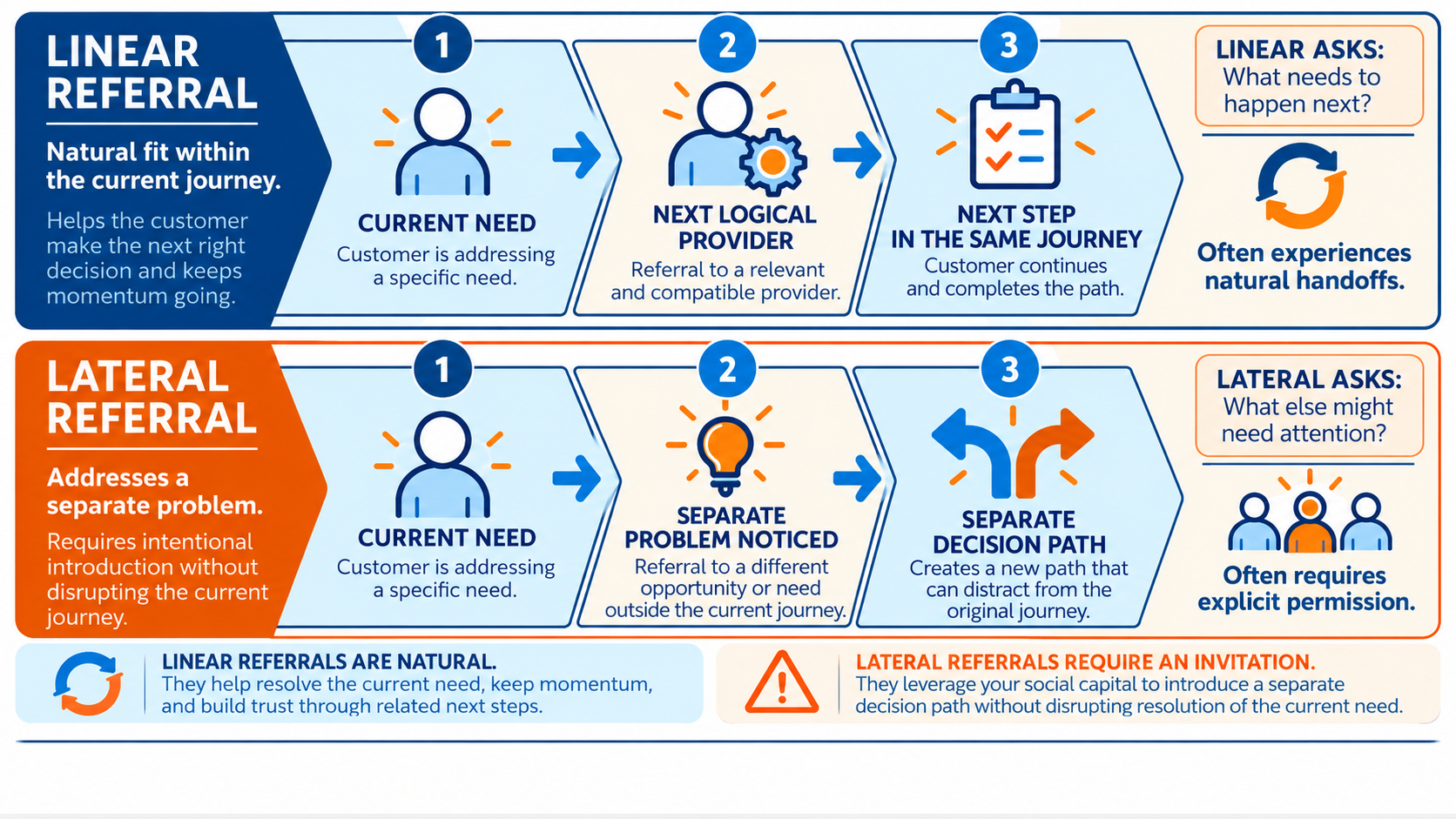
Power teams often work because their referrals are naturally sequential.
Their professions enjoy structurally favorable referral conditions.
The need is visible.
The relational permission is obvious.
The timing is appropriate.
The next step is easy to explain.
And making the referral helps advance the customer’s existing objective.
That is a very friendly environment for referral production.
It does not diminish the relationship-building skill of the people involved.
It simply means we should be careful about using their referral volume as the standard against which every other professional relationship is judged.
When the Opportunity Becomes Visible Is as Important as Whether It Becomes Visible
I learned another version of this lesson by disrupting someone else’s sales process.
A colleague, Devin Tracy, was working through an offer with a prospect.
During that process, I recognized another activity that I believed could also benefit the prospect.
The observation wasn’t necessarily wrong.
The opportunity was real enough.
But introducing it created a parallel conversation.
The prospect now had to think about the decision Devin was already helping them make and the additional opportunity I had introduced.
Which mattered more?
Should one happen first?
Were the two decisions connected?
Did the prospect need both?
Was the second activity a prerequisite for the first?
Had the original problem just become larger?
Should they delay Devin’s offer while considering the new idea?
I had introduced ambiguity into an existing decision process.
StoryBrand’s work on clear messaging is built around a familiar principle: confused minds do not buy easily. Clear decisions are easier to act on than competing or ambiguous ones.
My referral had done the opposite.
Instead of simplifying the prospect’s next decision, I added another decision loop.
The lesson has stayed with me:
WHEN an opportunity becomes visible is as important as whether it becomes visible.
A referral that advances the customer’s existing journey may simplify the next decision.
A referral that introduces another problem domain may complicate it.
Both referrals may ultimately be valuable.
They are not equally appropriate right now.
That is Timing Fit.
A Referral Can Be Accurate and Still Be Unhelpful
This deserves emphasis because networking cultures can unintentionally reward referral activity at the expense of referral relevance.
We count referrals.
We celebrate introductions.
We encourage members to look for opportunities for one another.
We invite testimonials and recommendations.
Those behaviors can be useful.
But the objective should not be to maximize the number of professionals we can insert into somebody else’s conversation.
A referral creates value when it improves the situation for the person being referred.
Sometimes the most professional thing a referral partner can do is recognize an opportunity and not introduce it yet.
That is not failure to follow through.
That is judgment.
Perhaps the person needs to finish the transaction already underway.
Perhaps another provider should enter after the current project is complete.
Perhaps the relationship is not yet strong enough to raise the issue.
Perhaps the need is better surfaced through content and self-identification.
Perhaps the prospect has explicitly indicated that they are overwhelmed and do not want another thing to think about.
Relationship-based marketing cannot operate as though the relationship is merely a conduit through which we push relevant vendors.
The relationship itself is part of the decision environment.
Referral Visibility May Explain Why Great Members Sit on the Sidelines
Return to the networking group.
Imagine two members.
Both are trusted.
Both attend consistently.
Both have educated the chapter well.
Both gladly and frequently refer business to other members.
Both understand how to make a good introduction.
One occupies a profession where referral opportunities constantly emerge from ordinary transactions.
The other solves a specialized problem that rarely surfaces in casual professional conversation, requires substantial trust before someone will disclose it, would be inappropriate for a third party to raise, or usually becomes relevant outside the buying journeys of other chapter members.
Should we really expect equal referral production from them?
I don’t think so.
Telling the second person simply to make better weekly asks may improve Recognition.
It does not necessarily improve Opportunity Visibility.
Teaching the chapter better trigger language may help people identify the need.
It does not automatically give them Relational Permission to raise it.
Building tremendous credibility may make everyone completely comfortable referring someone.
It does not guarantee that the right need will emerge at the right Timing Fit inside their normal conversations.
A person can become extremely referral-ready while remaining largely referral-invisible.
That is the distinction I had been missing.
The Merchant-Services Problem Is Different—but Related
The merchant-services professional I mentioned earlier presents a different version of the same structural problem.
His service was not particularly sensitive.
A business owner is unlikely to be offended because someone asks whether they are satisfied with credit-card-processing fees.
Relational Permission was not the primary constraint.
But switching payment processors is not a purchase a business makes every week.
A new business may need merchant services.
An established business may reconsider because of fees, service problems, new technology, changes in transaction volume, or dissatisfaction with its current provider.
Once the obvious opportunities inside a stable network have been worked through, however, new referrals depend on something changing.
A new business enters someone’s orbit.
An existing business reaches a trigger point.
A current provider creates a problem.
A new conversation reveals dissatisfaction.
The member could be excellent at networking and still encounter a lower frequency of visible opportunities than someone operating inside a naturally recurring transaction chain.
That does not mean the networking relationship has failed.
It may simply mean the environment cannot keep producing the same kind of opportunity at the same frequency.
Again, the constraint is not necessarily willingness.
It is not necessarily recognition.
It is not necessarily trust.
It is the architecture of the opportunity.
Contact List Size Doesn’t Tell Us Referral Contribution
This also changes how I think about someone having a “large network.”
A person may have thousands of contacts.
That tells me something about potential reach.
It tells me almost nothing by itself about actual referral contribution.
Referral contribution cannot be inferred from the size of someone’s contact list.
A person with 5,000 contacts may rarely have substantive conversations in which my problem becomes visible.
Another person with a few hundred strong professional relationships may spend every working day inside conversations where my kind of problem naturally appears.
That distinction fits comfortably inside established relationship-based referral thinking.
A connection is not the same thing as a trusted relationship.
I would simply add one more question:
Once the relationship exists, what kinds of conversations does that relationship actually contain?
This Changes How I Think About Referral Partners
I used to think primarily about whether another professional served the same kinds of people I served.
Now I think that is only an initial filter.
The better questions are:
Can this person recognize my opportunity in the wild?
Does their normal work naturally expose them to it?
How frequently does that happen?
When it happens, can they appropriately surface it without damaging their own relationship or interfering with their own work?
Does it tend to appear at a moment when an introduction helps rather than distracts?
And when all of those conditions line up, will they actually make a useful introduction?
That creates a very different way to think about potential referral relationships.
Someone who can recognize my opportunity is useful.
Someone who naturally encounters my opportunity is potentially much more useful.
Someone whose normal work makes my opportunity visible at the right moment and in a context where they have relational permission to act may be the exceptional referral partner everyone says they are looking for.
That person does not necessarily have the largest Rolodex.
They do not necessarily attend the most networking events.
They may not give the slickest weekly presentation.
Their advantage may simply be that the work they already do repeatedly puts them in the right conversation at the right moment.
Hard-to-Refer Businesses May Need a Different Strategy
None of this means specialized businesses do not belong in referral networks.
It means they may need a referral architecture appropriate to the problems they solve.
A business with low Opportunity Visibility may need unusually clear trigger language.
A business dealing with sensitive issues may need shareable content that allows prospects to self-identify.
A business whose service typically comes later in a customer journey may need relationships with professionals positioned immediately upstream.
A business that tends to receive lateral rather than linear referrals may need partners to introduce it after the primary transaction rather than during it.
A business with infrequent trigger events may need a larger or continually renewing network because the opportunity pool inside a static group can become saturated.
And some businesses may discover that direct referral networking simply should not carry the same share of their customer-acquisition strategy as it does for members of natural power teams.
That isn’t defeat.
That is marketing strategy.
The goal is not to force every business into the same referral model.
The goal is to understand the conditions under which that particular business can be referred naturally, responsibly, and consistently.
Referral Education Should Match the Referral Environment
This also changes what we should teach referral partners.
For some businesses, conventional referral education is exactly right:
“Listen for this phrase.”
“Look for this kind of business.”
“When this event happens, introduce me.”
For others, the education may need to be:
“If someone brings this subject up themselves, here is how to respond.”
Or:
“Don’t diagnose the person. Share this article and let them decide whether it applies.”
Or:
“This service normally becomes relevant after your part of the project is finished.”
Or:
“If they ask you a question you can’t answer, you don’t need to explain my service. Tell them why you trust me and offer the introduction.”
That is still referral education.
But it respects the architecture of the real conversation rather than pretending every referral can be generated through better prospect identification.
Referral Partners Need Feedback, Not Just Instructions
Referral education should not stop at teaching someone what to listen for.
It should also include a feedback loop after an introduction has been made.
Was this person actually a good fit?
Was the timing appropriate?
Did the referrer recognize the right problem?
Was the introduction useful, premature, vague, or too forceful?
What should the referrer listen for next time?
Without that feedback, referral partners are left guessing. They may repeat weak introductions, avoid making future introductions, or assume silence means the referral was appropriate.
If referral contribution is a capability, then it improves through practice and feedback. A good referral partner does not merely learn who you want to meet. They learn how to recognize, surface, and introduce the opportunity more accurately over time.
Referral Volume Is Not a Pure Measure of Networking Skill
I still believe people should learn how to refer someone or some business to one another.
They should understand what their referral partners do.
They should learn recognizable signals instead of memorizing service catalogs.
They should build enough trust that an introduction carries credibility.
They should know how to frame an introduction in a way that transfers useful context.
They should follow through when they see an appropriate opportunity.
Traditional referral training is right about all of that.
But I think we need one more layer.
We need to understand the architecture of the conversations in which referrals actually occur.
Because a willing referral partner may know exactly what to look for and still rarely encounter it.
They may encounter it and lack reasonable relational permission to raise the issue.
They may recognize it at exactly the wrong moment.
They may hesitate because they do not know how to bridge from recognition to a credible introduction.
Or their profession may simply place them outside the linear customer journey that makes some power partnerships so productive.
That means the question is not merely:
Have I prepared this person to refer someone to me?
We also need to ask:
Does this person’s ordinary work put them in a position where they can refer someone to me?
And, because this is relationship-based marketing:
Does the relational context permit them to do so when the opportunity appears?
That distinction may explain why some terrific networkers generate referrals week after week while other equally committed professionals sit quietly on the sidelines.
Not every referral problem is a relationship problem.
Not every referral problem is a training problem.
Not every referral problem is a lack-of-effort problem.
Sometimes it is an Opportunity Visibility problem.
Sometimes it is a Relational Permission problem.
Sometimes it is a Timing Fit problem.
And sometimes the business itself needs a different referral mechanism.
Once we recognize that, we can stop judging every relationship by the number of referrals it produces and start designing referral strategies around the conversations people are actually having rather than the conversations we wish they were having.


