How to Use a Tech Stack to Implement a Nine-Point Marketing Plan
Summary & Key Insights from My GHL Business Launch Training Session – Nov 17, 2024
Many small business owners (especially new HighLevel users) run into the same wall:
They dive straight into how to use the software long before they’ve decided what they should be doing with it.
HighLevel can automate almost anything.
But HighLevel cannot make strategic decisions for you.
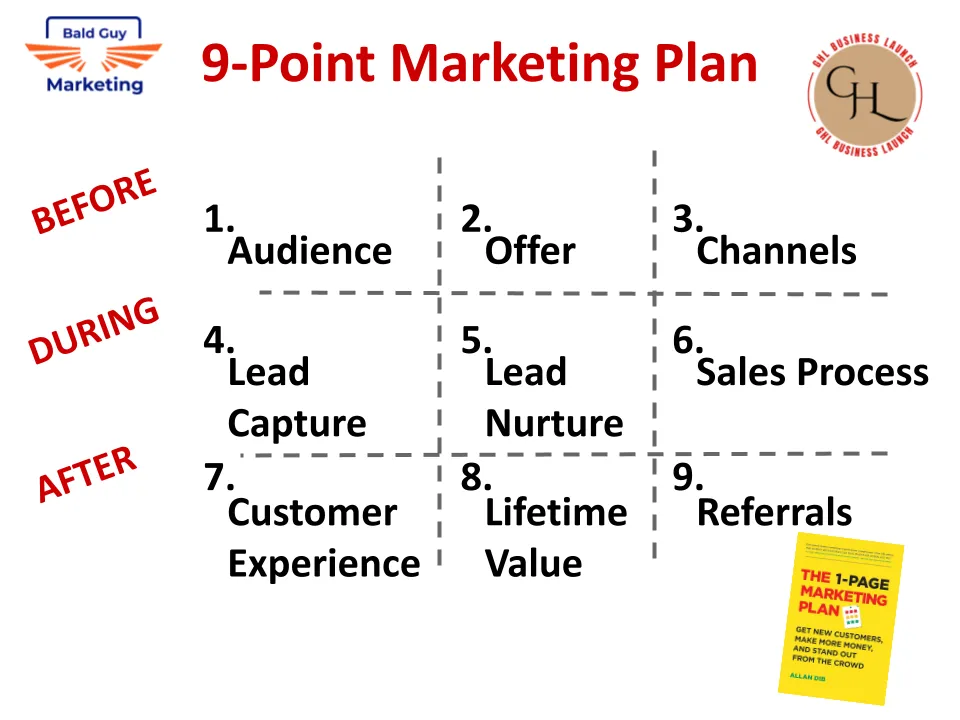
During this training session, I broke down how Allan Dib’s Nine-Point Marketing Plan connects with organic outreach, funnels, email workflows, and customer experience. My goal wasn’t to give another technical walkthrough of HighLevel. It was to show that tools serve strategy, not the other way around.
Below is a polished version of the core ideas I taught during the session.
1. Strategy Comes First — Tools Come Second
One of the most common assumptions I hear is:
“If I build the perfect funnel, the right people will automatically buy.”
But mastering your tech stack does not equal having a marketing strategy.
The first three points of the Nine-Point Marketing Plan are where the real leverage is created:
1. Target Audience; Who exactly are you speaking to?
Not a demographic.
Not “everyone who needs this.”
A well-defined, behavior-based segment.
2. Message / No-Brainer Offer; What are you saying that is irresistible only to your perfect-fit client?
A no-brainer offer feels mildly interesting to outsiders.
But to your ideal client, it feels like relief—finally, someone gets it.
3. Where They Listen; Which channels are already part of their daily life?
Where are they paying attention without you forcing your way in?
Your success is won or lost long before HighLevel, HubSpot, ActiveCampaign, Mailchimp, or any other tool enters the picture.
Most people skip the strategy and go straight to the tech, and then they wonder why the tech “isn’t working.”
2. The Real Challenge: We Assume Our Message Is Obvious
This is where most small business owners stumble.
We’re so close to our service that we assume:
people understand what we do
they can see the value as clearly as we do
they’ll connect the dots on their own
But prospects:
don’t know you
don’t understand your offer
don’t trust you yet
are distracted, overwhelmed, and skeptical
This is why I emphasize emphatically:
You must invest more time in strategy, not just funnel building.
Funnels amplify clarity — or confusion.
Tech won’t save a strategy that doesn’t yet exist.
3. Points 4, 5, and 6: Turning Attention Into a Sale
Once someone notices you, then your tech stack matters.
This is where the sales engine turns on.
4. Lead Capture: Identifying real prospects inside your audience
Lead capture can happen through:
responding to someone’s DM
meaningful engagement on social media
a lead magnet opt-in
a purchased lead list for cold email
Each method has completely different execution requirements.
5. Lead Nurture: Building trust and understanding
The relationship-building progression looks like:
I know you → I like you → I trust you → I’m willing to let you help me.
This is where most people fail, especially in cold outreach.
They push too fast.
They pitch too early.
They skip connection.
HighLevel can support this intelligently through:
workflows that adapt to behavior
triggered email sequences
conditional paths
AI-assisted messaging
automated but personalized follow-up
But again — the strategy dictates the workflow, not the other way around.
6. Sales Process: The moment when helping becomes an offer
This is when you’ve earned the right to say:
“Would you like help with that?”
Sales can happen:
naturally inside a DM exchange
on a phone call or Zoom meeting
through a triggered conversion sequence
via a tripwire purchase on a landing page
And I always remind people:
A funnel is not a landing page.
A funnel is a series of guided experiences that lead to a purchase.
4. Lead Capture, Nurture & Sales Across Different Channels
I walked through three practical implementation paths.
A. Organic Social Media
Lead Capture: Respond to posts in a meaningful, human way.
Lead Nurture: Ask thoughtful questions about their goals, challenges, and priorities.
Sales: “I hear what you’re trying to accomplish — would you like help with that?”
Organic outreach is built on generosity, curiosity, and timing.
B. Landing Pages & Funnels
Lead Magnets and Tripwire offers work because:
they solve a specific problem
they reveal a larger, underlying problem
they require minimal commitment
they justify a natural follow-up conversation
The flagship offer (the one that truly transforms their life or business) usually requires a deeper conversation.
That's why:
Lead Magnet & Tripwire = automation
Flagship = conversation
C. Cold Email Outreach
This method can work extremely well —
but only if the strategy is razor-sharp.
You must have:
a tightly refined audience
a relevant, emotionally resonant message
an offer that feels like a no-brainer
Otherwise:
you ruin your domain reputation
destroy future deliverability
and burn opportunities before they ever begin
HighLevel helps mitigate these risks by:
separating engaged vs. unengaged leads
tracking clicks and trigger-link behavior
dynamically adjusting workflows
removing people from sales sequences once they convert
Cold email can be a powerful tool, but only when strategic precision comes first.
5. Points 7, 8, and 9: Turning Sales into Raving Fans
This is where long-term profit actually happens.
7. Customer Experience: What happens after the purchase?
The experience a customer has after buying:
shapes trust
determines satisfaction
forms the basis of your reputation
For example, when someone buys a tripwire:
Did they use it?
Did it solve the problem?
What improvement would make the solution even better?
HighLevel helps by triggering the right questions at the right times in their journey.
Good tools make follow-up automatic.
Great strategy makes follow-up meaningful.
8. Lifetime Value: Turning first-time customers into long-term clients
Lifetime value grows through:
solving the next-level problem
delivering ongoing support
offering additional related services
maintaining consistent, value-driven communication
HighLevel workflows help guide customers from:
first interaction → to first result
first result → to next purchase
next purchase → to long-term relationship
When done right, every win creates momentum for the next one.
9. Reviews and Referrals: When trust becomes advocacy
Referrals and reviews don’t happen by accident.
HighLevel enables:
automated review requests
Google review and NPS prompts
(soon) video testimonial collection
website review display widgets
loyalty and reward automation
referral-driving follow-up sequences
My rule of thumb:
Ask often - but politely.
Ask at the right moments - not randomly.
Let automation support the request - not replace the relationship.
6. A Warning About Automation Gone Wrong
One of my strongest cautions during the training was this:
HighLevel itself continues retargeting me with ads encouraging me to “sign up for HighLevel,”
even though I’m already a customer.
Why?
Because their system sees me as several different contacts based on different email addresses.
This is a customer experience failure.
It breaks trust, creates confusion, and makes the brand feel disconnected.
Your automated systems must remove people from old sequences the moment they buy or take a meaningful action.
Otherwise automation becomes noise (or worse, friction).
7. The Big Picture
Here’s the core theme I emphasized during the session:
Tools don’t create strategy.
Strategy determines how tools should be used.
Automation amplifies what’s already there — good or bad.
Organic outreach, funnels, and email are all valid systems — if the strategy is correct.
HighLevel doesn’t fix poor strategy.
But with the right strategy in place, HighLevel becomes a force multiplier.
Your tech stack makes your work more efficient.
Your strategy makes your work effective.
Nail the strategy first — then let the tools do their job.


